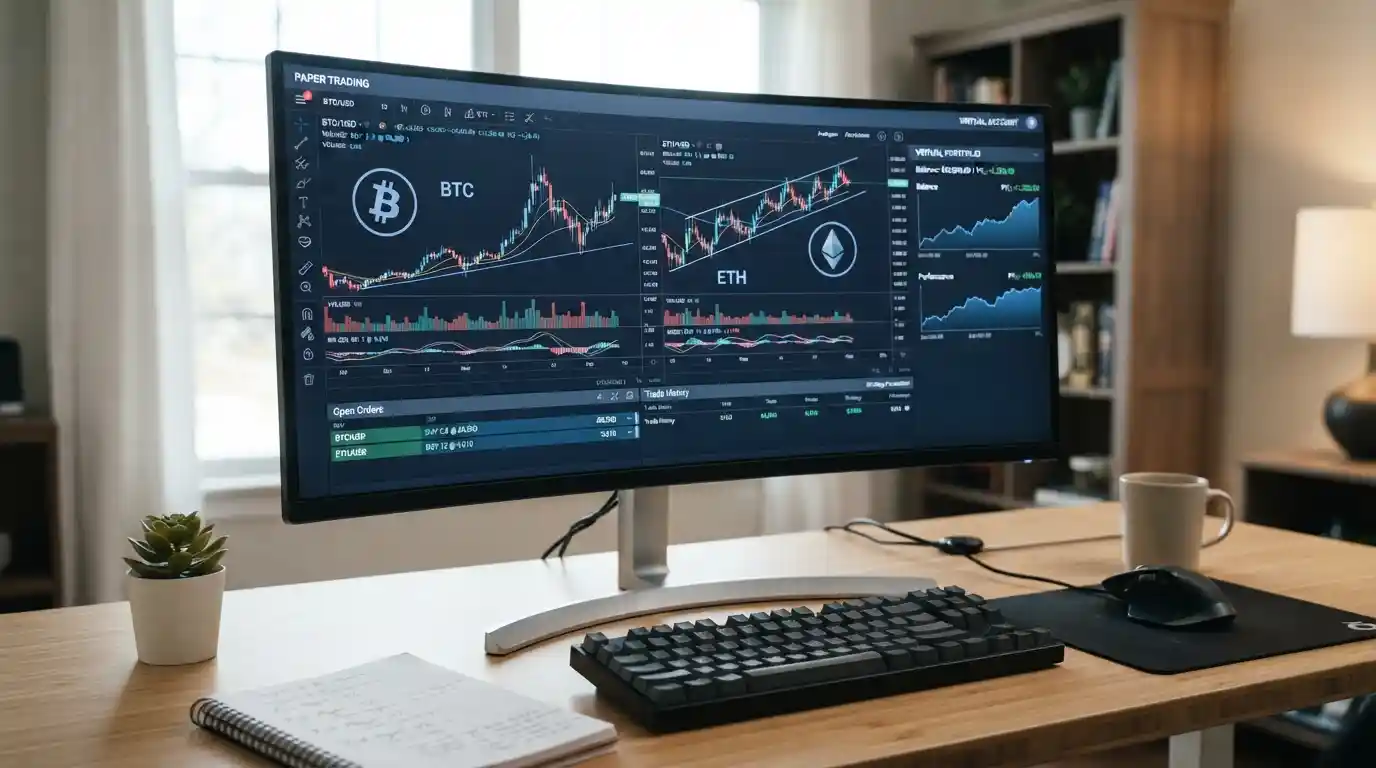
This approach can be especially useful in cryptocurrency markets, where prices can move quickly and emotions can influence trading decisions. Paper trading allows you to practice reading charts, testing entry and exit rules, managing positions, and evaluating risk before moving to live trading.
However, successful paper trading is more than clicking imaginary buy and sell buttons. To make the exercise valuable, you need realistic position sizes, a consistent strategy, accurate trade records, and rules that you would actually follow with real money.
What Is Cryptocurrency Paper Trading?
Cryptocurrency paper trading is a simulated trading method that allows you to practice buying and selling digital assets without using actual capital. A paper trading account typically starts with a virtual balance, while market prices are used to simulate potential trade outcomes.
For example, you might begin with a hypothetical $10,000 portfolio and decide to allocate a portion of it to Bitcoin. If the simulated Bitcoin position rises, your virtual account reflects the gain. If the price falls, the simulated account reflects the loss.
The objective is not simply to produce a positive virtual balance. The real objective is to determine whether your trading process is logical, repeatable, and capable of handling different market conditions.
Understanding the broader cryptocurrency ecosystem is also important before practicing. You can learn more about the relationship between different crypto assets and search behavior in our guide to cryptocurrency keywords.
How Cryptocurrency Paper Trading Works
The process is relatively straightforward. You select a paper trading environment, receive virtual funds, choose the assets you want to trade, establish a strategy, and record simulated transactions.
- Choose a simulation environment: Select a platform that provides the market data and trading features you need.
- Set a virtual balance: Establish an amount that resembles the capital you would realistically use.
- Select trading pairs: Focus on a manageable number of assets rather than attempting to follow everything at once.
- Create trading rules: Define your entry, exit, stop-loss, position-sizing, and risk-management rules.
- Execute simulated trades: Record each hypothetical transaction as though it were a real order.
- Track performance: Measure wins, losses, drawdowns, average returns, and other meaningful metrics.
- Review your decisions: Look for patterns in both successful and unsuccessful trades.
This structured process makes paper trading much more useful than casually predicting whether a cryptocurrency will rise or fall.
Why Paper Trading Can Be Useful for Crypto Traders
1. Practice Without Immediate Capital Exposure
The biggest attraction of cryptocurrency paper trading is the ability to practice without risking the money you would otherwise deposit into a live trading account.
This can make the learning process less intimidating. Instead of worrying about losing capital while learning basic order management, you can focus on understanding how your strategy behaves.
It does not mean live cryptocurrency trading is risk-free. It simply creates a controlled environment for developing skills before real capital is involved.
2. Test a Trading Strategy
A trading strategy may look convincing when described in theory but behave very differently when applied repeatedly.
Paper trading lets you test questions such as:
- Does the entry condition occur often enough?
- Are your exits too early?
- Are your losses significantly larger than your winners?
- Does the strategy perform better during trends than during sideways markets?
- Are you taking too many trades?
You can also compare discretionary trading with more systematic approaches. Traders interested in the technical side of market systems may find our coverage of social trading and platform infrastructure useful when thinking about how technology changes the trading process.
3. Improve Trading Discipline
Many trading mistakes happen because traders abandon their own rules after seeing a sudden price movement.
Paper trading provides an opportunity to practice following predetermined rules. If your strategy says you only enter after a specific setup appears, you can evaluate whether you actually wait for that setup.
The habit of following rules can become more important than any individual simulated trade.
4. Understand Position Sizing
Position sizing is one of the most important parts of risk management. A trader can have a reasonable strategy but still experience unacceptable losses by allocating too much capital to individual positions.
With paper trading, you can experiment with different position sizes and see how they affect portfolio volatility and drawdowns.
Paper Trading vs. Live Crypto Trading
Paper trading and live trading can look similar on the screen, but the psychological experience is very different.
| Factor | Paper Trading | Live Trading |
|---|---|---|
| Capital at risk | Simulated | Real money |
| Emotional pressure | Usually lower | Usually higher |
| Strategy testing | Highly useful | Real-world validation |
| Execution conditions | May be simulated | Actual market execution |
| Potential financial loss | No real trading loss from the simulated position | Possible |
The important distinction is that a profitable paper trading record does not guarantee profitable live trading. Real orders can involve execution differences, fees, spreads, liquidity conditions, and emotional pressure.
Cryptocurrency Paper Trading for Beginners
Beginners should keep their first paper trading strategy simple. Attempting to combine numerous indicators, complicated technical patterns, leverage assumptions, and multiple markets can make it difficult to understand what is actually driving the results.
A better approach is to choose one market, one basic strategy, and a clearly defined risk model.
For example, a beginner might create rules around trend direction, support and resistance, and a predefined exit. Every trade can then be recorded in a journal with the reason for entry and the reason for exit.
If you are still learning how cryptocurrency markets work, understanding the difference between an exchange and a wallet is another useful foundation. Our guide on cryptocurrency exchanges vs. wallets covers that distinction.
How to Build a Cryptocurrency Paper Trading Strategy
Define Your Trading Objective
Start by deciding what you are trying to learn. Your objective might be improving technical analysis, testing swing trading, practicing short-term entries, or learning how portfolio allocation affects risk.
A specific objective gives your paper trading experiment a measurable purpose.
Choose a Small Number of Assets
Following dozens of cryptocurrencies at once can create unnecessary noise. Start with a small watchlist and learn how those assets behave.
Bitcoin and Ethereum are often used as reference markets because they are widely followed, but your paper trading exercise should ultimately reflect the assets and strategy you intend to study.
Set Entry Rules
Your entry should be based on an identifiable condition rather than a vague feeling that an asset is about to rise.
Possible conditions could include a technical setup, a breakout, a trend continuation pattern, or a predetermined price relationship.
Set Exit Rules
Before entering a simulated position, determine what would cause you to exit. This can include a target, a stop-loss condition, a change in market structure, or a specific time-based rule.
Predefined exits make it easier to determine whether your strategy actually works instead of changing the rules after every trade.
Establish Position Size
Use a consistent position-sizing method. If your simulated account contains $10,000, for example, you should not suddenly place an oversized position simply because you feel especially confident about one trade.
Consistency makes the resulting performance data more meaningful.
How to Keep a Crypto Paper Trading Journal
A trading journal can turn simulated trading into a structured learning experiment.
For every trade, record:
- Date and time
- Cryptocurrency or trading pair
- Entry price
- Exit price
- Position size
- Reason for entering
- Reason for exiting
- Planned risk
- Simulated profit or loss
- Market conditions
- Emotional state or decision-making notes
After several trades, review the journal instead of focusing on individual wins. Look for repeated behaviors that either strengthen or weaken your process.
Important Metrics to Track
A virtual account balance alone does not provide enough information to evaluate a strategy. Several additional metrics can help you understand performance.
Win Rate
Win rate shows the percentage of trades that finish profitably. A high win rate is not automatically evidence of a good strategy because large losses can outweigh many small wins.
Average Winning Trade
This measures the average gain from profitable trades and can be compared with the average losing trade.
Average Losing Trade
Knowing the typical loss helps you determine whether the strategy’s risk profile is reasonable.
Maximum Drawdown
Drawdown measures the decline from a portfolio peak to a subsequent low. It can help you understand how difficult a strategy may be to maintain during unfavorable periods.
Risk-to-Reward Profile
Comparing potential losses with potential gains can help reveal whether your strategy has a coherent risk structure.
Common Cryptocurrency Paper Trading Mistakes
Using Unrealistically Large Positions
One of the most common mistakes is starting with a virtual account and taking enormous positions because there is no real financial consequence.
If you intend to transition to live trading, your simulation should resemble your realistic financial situation.
Ignoring Trading Fees
Some simulations can make strategies look better than they would be in live markets because transaction costs are not properly considered.
When evaluating a strategy, account for realistic costs wherever your chosen simulation allows it.
Changing the Rules After Every Loss
A losing trade does not automatically mean the entire strategy is broken. If you constantly change your rules after individual losses, you may never collect enough consistent data to evaluate the original strategy.
Trading Only During Easy Markets
A strategy that performs well during a strong upward trend may struggle during sideways or declining markets.
Try to evaluate your strategy across different market conditions rather than selecting only periods that make the strategy look successful.
Taking Paper Profits Too Seriously
A simulated profit can be encouraging, but it should not be treated as proof that you are ready to risk significant real capital.
Paper trading is a learning and testing environment, not a guarantee of future performance.
Cryptocurrency Paper Trading and Risk Management
Risk management should be part of your paper trading plan from the beginning rather than something added after a strategy produces losses.
Consider defining a maximum acceptable loss per trade, maximum portfolio exposure, maximum number of simultaneous positions, and maximum daily or weekly loss.
These rules can help you understand how your strategy behaves when several trades move against you at the same time.
The broader concept of financial risk management also appears in other investment-related topics. For example, financial planning and trusted finance solutions can provide useful context around responsible financial decision-making.
Can You Paper Trade Cryptocurrency With a Small Account?
Yes. In fact, using a virtual balance that resembles your intended live account can make the exercise more realistic.
Someone planning to trade a small amount should avoid creating a simulation with an enormous virtual balance simply because it makes the results more exciting. The purpose is to understand how the strategy behaves under realistic constraints.
The same principle applies to position sizing, number of trades, and acceptable drawdown.
Paper Trading and Automated Crypto Strategies
Paper trading can also be useful when evaluating automated or rule-based trading ideas.
Before allowing an automated system to interact with real markets, simulated testing can help identify obvious logic problems, unexpected entry conditions, position-sizing mistakes, and other issues.
Technology is increasingly influencing how traders analyze and interact with markets. Our coverage of AI tools provides broader context on how artificial intelligence is becoming part of modern digital workflows.
For developers experimenting with trading-related software, understanding programming environments can also be valuable. Our article on Python and development tooling offers a related technical perspective.
Exploring Crypto Mining and Other Digital Asset Concepts
Paper trading focuses on market participation, but cryptocurrency has a much wider technology ecosystem. Readers interested in how crypto technology can operate outside conventional exchange trading can explore our guide to mobile cryptocurrency mining.
Similarly, price analysis can be applied to individual assets and broader market themes. Our discussion of Chainlink cryptocurrency price analysis illustrates how individual digital assets can become the focus of market research.
These topics should not be confused with paper trading itself. Mining, investing, and simulated trading involve different objectives, risks, and processes.
How Long Should You Paper Trade Crypto?
There is no universal number of days or trades that proves a trader is ready for live markets.
Instead, focus on whether you have collected enough consistent data to evaluate your strategy across different conditions.
A useful paper trading period should give you enough opportunities to experience winning trades, losing trades, periods of inactivity, and changing market conditions.
You should also be able to explain why the strategy works, where it fails, and what circumstances should cause you to stop using it.
When Should You Move From Paper Trading to Live Trading?
Moving from simulation to live trading should not be based solely on achieving a certain virtual profit percentage.
Before considering the transition, ask yourself:
- Can I follow my trading rules consistently?
- Do I understand the strategy’s major weaknesses?
- Have I tested it across different market conditions?
- Do I understand position sizing and risk limits?
- Can I accept losing trades without immediately abandoning the strategy?
- Would the amount of money involved be financially manageable if losses occur?
If the answer to these questions is unclear, additional practice may be more useful than rushing into live markets.
Paper Trading, Portfolio Thinking, and Financial Discipline
One advantage of simulation is that it allows you to think beyond individual trades.
You can experiment with how several positions interact, how much capital remains available, and how concentrated or diversified your simulated portfolio becomes.
This broader perspective can help separate trading decisions from impulsive bets.
For readers interested in investment and asset-related business models, our coverage of alternative real estate investment provides another example of how different asset classes require different approaches to evaluating risk and potential returns.
How Cryptocurrency Paper Trading Can Improve Your Trading Process
The strongest benefit of paper trading is not that it promises profitable trading. Its value comes from giving you a repeatable environment in which to test decisions.
Instead of asking whether your next trade will make money, you can ask better questions:
- Was the trade consistent with my strategy?
- Was my position size appropriate?
- Did I follow my entry criteria?
- Did I respect my exit rules?
- Was the market condition suitable for this strategy?
- What can I learn from this result?
This shift from prediction to process can make simulated trading considerably more educational.
Technology Behind Modern Trading Platforms
Modern trading platforms rely on sophisticated digital infrastructure to deliver market data, account management, charting, order interfaces, analytics, and other tools.
That broader technology trend is part of a much larger transformation affecting businesses and financial services. Our coverage of digital transformation explores how technology is changing modern commercial operations.
For readers interested in how technology is affecting different industries, our broader analysis of advanced digital strategies provides additional context about technology-driven decision-making.
Is Cryptocurrency Paper Trading Completely Risk-Free?
Paper trading removes the direct financial loss associated with the simulated trades themselves, but calling the entire process completely risk-free would be misleading.
The biggest risk is psychological and educational: a trader may become overconfident because simulated trading does not reproduce every pressure associated with losing real money.
There can also be differences between simulated and live execution. Depending on the platform, a simulation may not perfectly reproduce liquidity, slippage, order fills, fees, latency, or other real-world conditions.
For that reason, paper trading should be viewed as preparation rather than a guarantee.
Final Thoughts on Cryptocurrency Paper Trading
Cryptocurrency paper trading can be an effective way to learn market mechanics, test trading strategies, practice risk management, and develop a more disciplined decision-making process without immediately putting trading capital at risk.
The key is to treat the simulation seriously. Use realistic capital assumptions, maintain consistent rules, record every trade, evaluate performance using meaningful metrics, and test your approach across different market conditions.
Most importantly, remember that a successful paper trading record does not guarantee live-market success. Real trading introduces financial consequences and emotional pressure that a simulation cannot perfectly reproduce.
Used correctly, however, paper trading can provide a valuable bridge between learning about cryptocurrency markets and understanding how a structured trading process performs before real capital becomes involved.