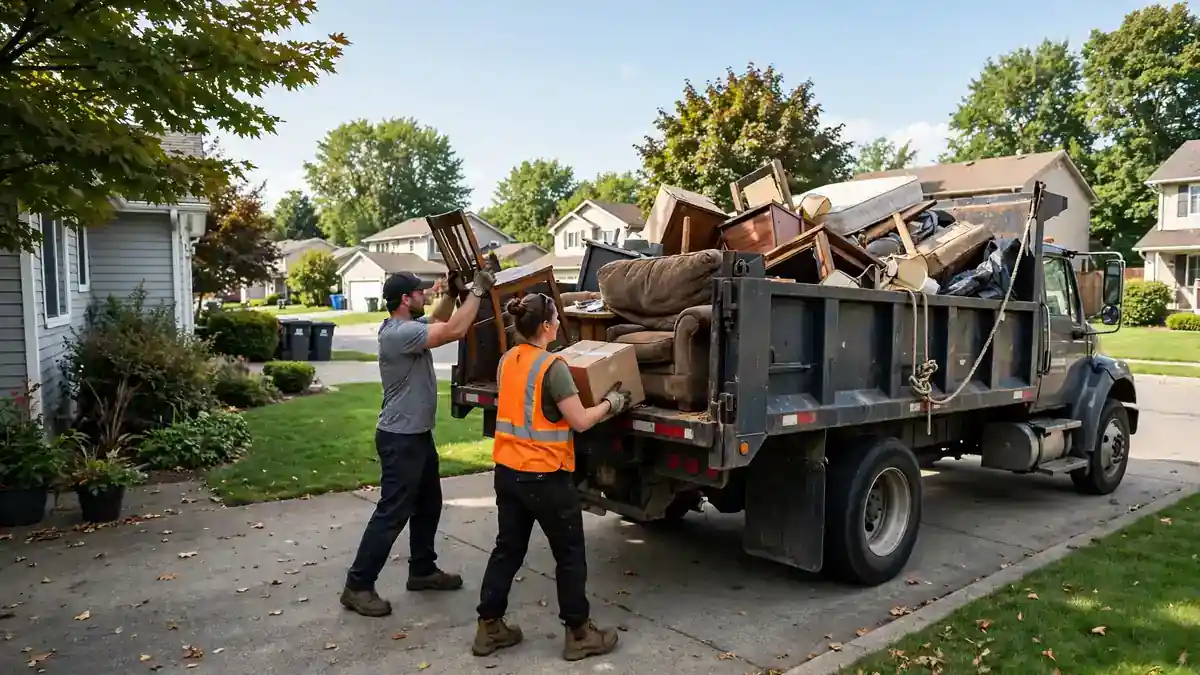
Every American garage, basement, and storage unit holds the same thing: stuff the owner no longer wants but has no easy way to get rid of. Old mattresses, broken furniture, renovation debris, yard waste — and most people will gladly pay a few hundred dollars to watch it all disappear in an hour. That is the simple economics behind the junk removal business, one of the highest-demand local service businesses you can start in 2026.
A junk removal business runs on a truck, a strong back, and good marketing. Startup costs are higher than some service businesses because of the vehicle, but the revenue per job is excellent — most operators charge $150 to $600 per load, and a good crew can run multiple loads a day. This guide covers everything: 2026 startup costs, the right truck, pricing by volume, dump fees, licensing and insurance, and how to fill your schedule.
How a Junk Removal Business Makes Money
The model is volume-based pricing. You quote a job based on how much truck space the junk fills — typically priced in fractions of a truckload (quarter load, half load, full load) — then haul it to a landfill, transfer station, recycling center, or donation drop-off. Your profit is the gap between the quoted price and your disposal costs, fuel, labor, and insurance.
Common job types include:
- Residential cleanouts: furniture removal, mattress hauling, garage and basement cleanouts, estate cleanouts.
- Renovation debris: construction waste, drywall, flooring, and old fixtures.
- Yard debris: fallen branches, landscaping waste, and storm cleanup.
- Commercial work: office cleanouts, retail fixture removal, and property management turnover cleanouts.
Estate cleanouts and property-management turnovers are the repeat business that stabilizes revenue — one relationship with a property manager can fill weeks of your calendar. Like its service-business cousin, a junk removal business grows on reliability and reviews; compare the marketing dynamics in how to start a car detailing business.
Startup Costs for a Junk Removal Business in 2026
A realistic budget for a junk removal business in 2026 runs $15,000 to $50,000, with the truck being the dominant expense:
- Used box truck or dump truck: $10,000–$30,000 (the workhorse of the business)
- Trailer as a starter option: $2,000–$6,000 (if you already own a capable pickup)
- Equipment — dollies, straps, tarps, tools, gloves: $500–$1,500
- General liability + commercial auto insurance: $3,000–$6,000 per year
- Business license, registration, signage: $500–$1,500
- Website, branding, uniforms, initial marketing: $1,000–$3,000
- Working capital (fuel, dump fees, first payroll): $2,000–$5,000
Many operators start with a pickup truck and a dump trailer to keep costs near the bottom of that range, then upgrade to a box truck once revenue justifies it. If you need financing for the truck, review SBA loans explained — vehicle purchases are one of the most common uses of small-business lending.
Choosing the Right Truck
Your truck is your factory floor. A 14–16 foot box truck is the industry standard for full-time operations because it holds large volumes, protects workers with a low loading height, and doubles as a rolling billboard with a vinyl wrap. Key considerations:
- Payload capacity: junk is heavy — make sure the truck’s GVWR handles full loads of furniture and debris.
- Condition over cosmetics: buy on mechanical condition; a wrap hides dents cheaply.
- Fuel economy: you will drive constantly; diesel box trucks cost more upfront but often win on longevity.
- Dump capability: a dump trailer or dump insert saves enormous unloading time at the landfill.
Inspect any used truck thoroughly, check the title, and verify it meets your state’s commercial vehicle regulations. Starting with a trailer behind a truck you already own is the lowest-risk entry — it also qualifies this as a viable path to start a business with no money in the lean-startup sense, since the biggest cost is sweat equity.
Licenses, Insurance, and Legal Requirements
Junk removal sits at the intersection of hauling, disposal, and labor — and regulators notice. Get this right before your first job:
- Business entity: an LLC is the standard choice for liability protection. See the sole proprietorship vs LLC breakdown for the details.
- Hauling permits: many cities and counties require a waste-hauler license or permit; some landfills require a hauler account to dump.
- Commercial auto insurance: your personal auto policy does not cover business hauling — this is a separate, mandatory expense.
- General liability: $1M/$2M is standard; commercial clients and property managers will ask for certificates.
- Workers’ comp: required once you hire employees in most states.
- EPA and local dumping rules: illegal dumping carries heavy fines — know exactly where each material type is accepted and what it costs per ton.
Know your disposal costs cold: landfill tipping fees typically run $50–$150 per ton, and they vary wildly by county. Misquoting a heavy job because you guessed at the dump fee is a classic beginner error. Where you form the company can also affect costs — see best states to start an LLC for a state-by-state comparison.
How to Price Junk Removal Jobs
Volume-based pricing is the industry standard. In 2026, typical US rates look like this:
- Minimum / curbside pickup: $75–$150
- Quarter truckload: $150–$250
- Half truckload: $250–$400
- Full truckload: $400–$700
- Estate / hoarding cleanouts: $1,000–$5,000+ (quoted per project)
Price in person or from detailed photos whenever possible — customers consistently underestimate their junk volume. Build your quote as: disposal cost + fuel + labor hours + overhead allocation + target profit. Never quote a flat number over the phone for a full cleanout sight unseen.
Raise prices as demand grows. The operators who stay busy are rarely the cheapest — they are the fastest to respond and the most professional on-site. Putting your numbers on paper first helps; how to write a business plan shows how to model pricing and cash flow before you commit.
Where to Dump: Disposal Strategy That Protects Margins
Disposal is your largest variable cost, so treat it as a strategy, not an afterthought:
- Landfills and transfer stations: compare tipping fees across every facility within driving distance — a $30/ton difference adds up fast.
- Scrap metal yards: metal junk earns you money instead of costing you; separate it on every job.
- Donation centers: usable furniture and appliances go to charities — some offer tax receipts and all of them reduce your dump fees.
- Recycling: electronics, cardboard, and yard waste often have cheaper (or free) disposal streams.
- Resale: many operators sell decent furniture and appliances on marketplace sites, turning a cost center into bonus revenue.
The “green” angle is also a marketing asset: customers feel better hiring the company that donates and recycles instead of landfilling everything. Market it on your website and truck.
Getting Customers: Marketing That Fills the Truck
Junk removal is an intent-driven business — people search when the need is urgent. Your marketing must capture that moment:
- Google Business Profile + local SEO: “junk removal near me” is one of the highest-converting local searches in any market. Reviews here are everything.
- Google Ads: expensive per click but extremely high intent; even a small budget works if your landing page converts.
- Yard signs and truck wraps: your truck is a billboard — wrap it. Simple signs near the job site (“We just cleaned out this street — need junk gone?”) pull neighbor calls.
- Property managers and realtors: offer fast, reliable turnovers; one manager can send dozens of jobs a year.
- Nextdoor and Facebook: local groups are gold for same-week bookings.
Speed wins: the company that answers the phone first usually gets the job. Use a dedicated business line, answer during business hours, and quote quickly. Most founders start part-time — how to start a side business covers running the operation around a day job until revenue replaces your paycheck.
Realistic Profit Margins and Income
A well-run junk removal business holds 30–50% net margins after disposal fees, fuel, insurance, and labor. The math per load is straightforward: a $450 full-load job might cost $120 in dump fees, $60 in fuel and labor allocation, and $40 in insurance/overhead — leaving roughly $230 in profit before owner pay.
Solo operators commonly gross $100,000–$200,000 per year; two-truck operations in strong markets pass $400,000. Scaling means adding trucks and crews, and each truck becomes a profit center once marketing keeps it booked. For context on what is realistic in the current market, browse small business ideas to see how junk removal stacks up against other service models.
Mistakes That Sink New Junk Removal Businesses
- Underpricing disposal costs: always know the tipping fee before you quote.
- Skipping commercial insurance: an accident in an uninsured work truck can end the business.
- Illegal dumping: fines, reputation damage, and criminal charges in some jurisdictions.
- No-shows and slow response: this is a same-day business; responsiveness is the product.
- Ignoring the resale stream: leaving money on the curb instead of reselling usable items.
- Buying too much truck too early: let revenue justify the upgrade, not optimism.
Junk Removal Business FAQ
Do I need a CDL to start a junk removal business?
Usually not. Most box trucks used in junk removal stay under the 26,001-pound GVWR threshold that triggers CDL requirements, but check your state’s exact rules before buying.
How much does it cost to dump a truckload of junk?
Landfill tipping fees typically run $50–$150 per ton depending on the county, plus fuel and time. Heavy materials like construction debris cost far more to dump than light household junk — price accordingly.
Is junk removal profitable in 2026?
Yes — demand is strong and margins of 30–50% are realistic for disciplined operators. The winners are fast responders with good reviews, not the cheapest quotes. The fundamentals in how to start a small business in the USA apply directly: know your numbers, market relentlessly, and protect your reputation.
Can I start a junk removal business with just a pickup truck?
Yes — a pickup with a dump trailer is the classic lean start. You will make fewer dollars per load than a box truck, but the lower overhead lets you learn the business with minimal risk.
Conclusion: Is a Junk Removal Business Worth Starting?
If you want a business with obvious demand, same-week cash flow, and a clear path from one truck to a fleet, a junk removal business deserves serious consideration in 2026. The work is physical and the disposal logistics take learning, but the economics are honest: quote right, dump smart, answer fast, and the truck stays full.
Start lean with a truck or trailer you can afford, lock in your disposal relationships, get insured, and chase reviews from job one. And if you want a comparable entry-level service model for comparison, how to start a vending machine business shows a very different — but equally accessible — route to self-employment.