
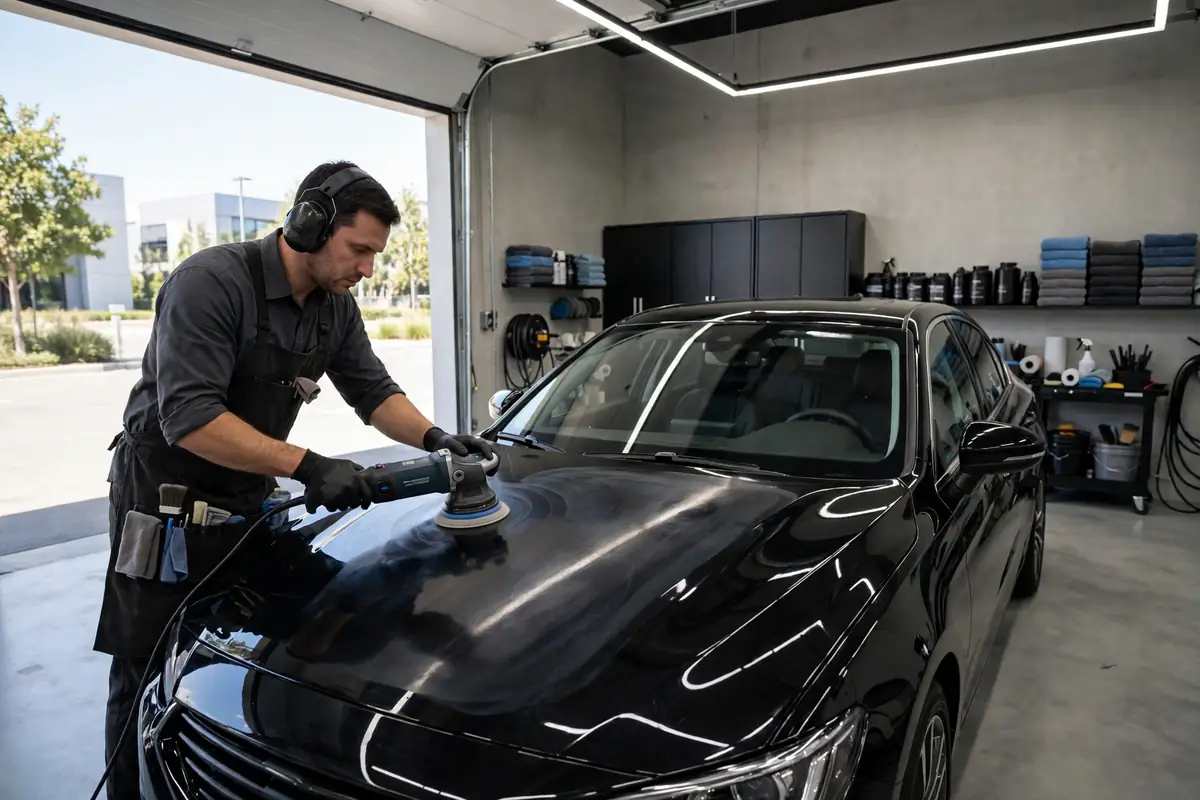
America loves its cars — and Americans pay good money to keep them looking showroom-new. The car detailing business is one of the most accessible service businesses you can start in the USA: low startup costs, no storefront required, skills you can learn in weeks, and customers who come back again and again. In 2026, with mobile detailing booming, you can literally run the whole operation from your driveway and a van.
This guide walks through how to start a car detailing business from scratch: startup costs, equipment lists, pricing, legal setup, finding your first customers, and scaling from side hustle to full-time income. Whether you want weekend cash or a real company with employees, the roadmap starts here.
How to Start a Car Detailing Business: What the Business Actually Looks Like
Detailing is not a car wash. A car wash cleans the surface; a detailer restores and protects it — paint correction, ceramic coatings, interior deep extraction, odor removal, engine bay cleaning. That difference is why detailing commands $150 to $400+ per vehicle while a drive-through wash charges $15.
There are two main models. A fixed-location shop gives you controlled lighting, water, and power, and projects a premium image. A mobile detailing business — you drive to the customer’s home or office — has far lower overhead and is how most beginners start. Many successful operators begin mobile and open a shop once demand justifies it.
The economics are attractive. Product cost per detail runs roughly $15 to $40. At $200 per job and two jobs a day, a solo mobile detailer can gross $2,000 a week. Your constraints are marketing, scheduling, and your own two hands — all solvable.
Startup Costs: What You Really Need to Spend
One of the best things about a car detailing business is how cheap it is to start properly. A beginner mobile setup runs $2,000 to $5,000 all-in. A premium setup with a dedicated van, water tank, and generator can reach $15,000 to $25,000, but you do not need that on day one.
Your essential equipment list:
- Pressure washer (electric, 1,800+ PSI) — the backbone of exterior work.
- Wet/dry vacuum and extractor — interior cleaning lives or dies on extraction power.
- Dual-action polisher plus pads and compounds — for paint correction services.
- Chemicals: car shampoo, all-purpose cleaner, degreaser, glass cleaner, iron remover, clay bars, tire dressing, interior protectant.
- Microfiber towels, brushes, and buckets with grit guards — buy quality; cheap towels scratch paint.
- Water supply: portable tank or a hose connection at the customer’s location.
- Generator (for mobile) or reliable power access.
Start with the essentials and upgrade as revenue comes in. The most expensive mistake beginners make is buying a $25,000 rig before booking a single customer.
Learn the Craft Before You Charge
Detailing is a skill trade — bad work gets you bad reviews that follow you forever. Practice on your own car, then friends’ and family cars, until your work is consistently excellent. Watch professional detailers, take an online certification course, and learn paint correction on junk panels before touching a customer’s $60,000 truck.
Pay special attention to the services with the highest margins: paint correction ($300–$800), ceramic coating ($500–$2,000+), and interior restoration for neglected vehicles. These are the jobs that separate a $75 “wash guy” from a $400 professional detailer.
Legal Setup: Business Structure, Licenses, and Insurance
Set up the business properly from day one. Most detailers form an LLC rather than operating as a sole proprietorship — the liability protection matters when you are working on other people’s expensive vehicles. Our comparison of the best states to start an LLC covers where to file and what it costs.
You will need a general business license from your city or county, and some areas require a home-occupation permit if you operate from home. Check local rules on water runoff — several states and municipalities restrict where wash water can drain, and mobile detailers increasingly use waterless or rinseless methods and containment mats to comply.
Insurance is non-negotiable. General liability plus garage-keepers coverage protects you if you damage a customer’s vehicle. A scratched bumper without insurance can wipe out months of profit. Expect a few hundred to around a thousand dollars per year for a basic policy — cheap peace of mind.
Write It Down: Your Business Plan
Even a one-page plan keeps you honest. Writing a business plan forces you to define your services, pricing, target customer, and monthly revenue goal. If you ever want equipment financing, our SBA loans explained guide shows how lenders evaluate small service businesses — and they all ask for the plan first.
How to Price Your Detailing Services
Price by package, not by hour — customers buy results, not your time. A proven three-tier structure for 2026:
- Maintenance detail ($99–$149): wash, wheels, tires, windows, interior vacuum and wipe-down. Your volume driver and repeat-business engine.
- Full detail ($199–$349): everything above plus shampooing, wax or sealant, trim restoration, and deep interior work. Your core profit center.
- Premium correction and coating ($500–$2,000+): multi-stage paint correction, ceramic coatings. Fewer jobs, highest margin, strongest reputation builder.
Research local competitors, then price at or slightly above the market if your quality justifies it. Racing to the bottom attracts the worst customers. Offer maintenance plans — a monthly $129 subscription for a busy professional’s car creates predictable recurring revenue, the holy grail of service businesses.
Finding Your First 20 Customers
Your first customers come from hustle, not ads. Start with your personal network and ask every satisfied customer for a review and two referrals. Then:
- Google Business Profile: claim it, add 30+ photos of your best work, and collect reviews relentlessly. This is your #1 lead source within months.
- Before-and-after content: post transformation photos and videos daily. Our social media marketing strategy playbook shows how local service businesses turn content into bookings.
- Neighborhood apps and groups: Nextdoor and local Facebook groups are goldmines for mobile detailers.
- Strategic partnerships: introduce yourself to used car dealers, real estate agents (they need listing-ready cars), and corporate fleet managers. One dealership account can fill your week.
- Door hangers and flyers in affluent neighborhoods with visible results — old school, still works.
These digital marketing strategies for small businesses scale perfectly as you grow from solo operator to a booked-out schedule.
Related Service Insights Worth Reading
Detailing shares DNA with other successful local service businesses. Study how service pros operate: our guide to home cleaning services shows how recurring residential service routes are built, and these auto care guides — Dempster Auto Service and Kidder Auto Services — reveal how trusted vehicle-care businesses earn repeat customers. Borrow their playbook: reliability, transparency, and spotless results.
Systems: The Difference Between a Job and a Business
From day one, run it like a business. Use booking software (even a free one) so customers can schedule online. Send automated reminders to cut no-shows. Track every job’s revenue, product cost, and time — your effective hourly rate tells you which services to promote and which to reprice or drop.
Protect your cash flow like any smart owner: keep business money separate, pay yourself a consistent amount, and follow the full small-business startup checklist so taxes, licensing, and bookkeeping never become emergencies. Slow months happen in every seasonal trade — a cash cushion turns them from crises into vacations.
Scaling: From Solo Operator to Detailing Company
Once you are booked two to three weeks out, you have a decision: raise prices, hire help, or both. Most successful detailers do both — raise prices 15 to 20 percent, then hire and train a helper using your documented processes. A second van doubles capacity without doubling your marketing cost. Document every process on video as you train: your future employees should be able to replicate your quality without you standing over their shoulder, because the business only scales when the work no longer depends entirely on your hands.
Longer term, options include opening a fixed shop, adding paint protection film (PPF) services, or building a multi-crew mobile operation. Each step multiplies revenue while your reputation — built one flawless detail at a time — does the marketing for you.
Is a Car Detailing Business Right for You?
If you take pride in meticulous work, enjoy working with your hands, and can sell yourself confidently, car detailing is one of the highest-return businesses you can start for under $5,000. The demand is permanent — Americans will always own cars, and they will always want them to look great.
Start this weekend: detail a friend’s car, photograph everything, post the transformation, and ask for your first paying customer. The barrier to entry is low, which means the only thing standing between you and a real detailing business is the decision to begin. Six months from now, you could be looking back at a booked-out schedule and wondering why you waited — every successful detailer started exactly where you are right now, with a bucket, a vacuum, and the willingness to do excellent work.