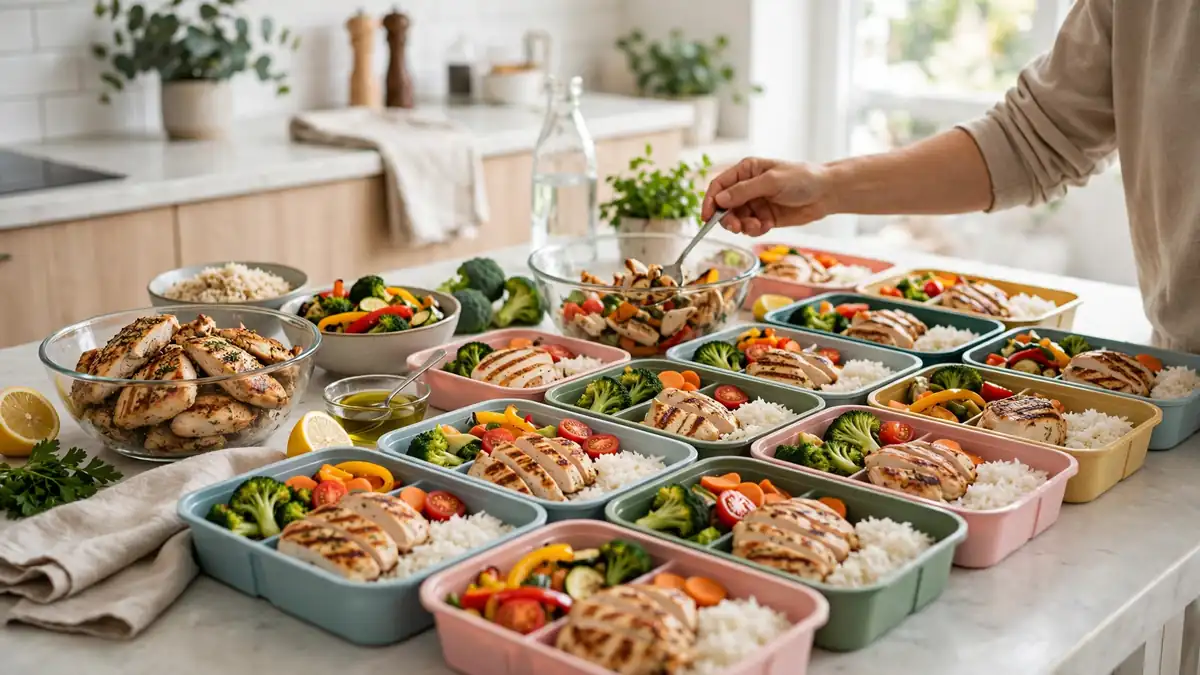
Most weight loss attempts do not fail at breakfast. They fail at 6:30 p.m., when you are tired, hungry, and staring into the fridge with no plan, while a food-delivery app glows on your phone. In that moment, willpower loses almost every time. Meal planning removes the moment entirely. When a healthy dinner is already decided, shopped for, and half-prepared, eating well becomes the path of least resistance instead of a daily battle.
This beginner’s guide shows you exactly how meal planning for weight loss works: setting your targets, building a weekly template, shopping smart, prepping in about two hours, and staying flexible when life interrupts. It pairs naturally with the broader approach in how to lose weight safely, because a plan you can repeat is the engine that makes a calorie deficit effortless.
Why Meal Planning Works for Weight Loss
Planning works for three reasons. First, it moves decisions to a calm moment. Choosing meals once, on a quiet Sunday morning, produces far better choices than deciding nightly while hungry. Second, it controls portions automatically: food you cook at home typically contains far fewer hidden calories than restaurant portions, which often exceed 1,000 calories for a single dish. Third, it builds consistency, and consistency is what separates people who keep weight off from those caught in the cycle described in why diets fail.
There is a financial bonus too. Planned shopping lists cut impulse buys and food waste, and home cooking built around affordable staples can save hundreds of dollars a month, as the strategies in healthy eating on a budget demonstrate. Your wallet gets healthier alongside your waistline.
Step 1: Set Your Calorie and Protein Targets
Before planning a single meal, you need two numbers. The first is your daily calorie target: estimate your maintenance calories with a reputable calculator, then subtract about 300 to 500 calories for a steady loss of roughly half a pound to a pound per week. The second is your protein target, around 0.7 grams per pound of your goal body weight. Protein is the planner’s best friend because it keeps you full and protects muscle; this detailed guide to how much protein you need helps you convert that target into real servings of food.
Divide your calories across the day in a pattern that matches your hunger. Many beginners do well with three meals and one planned snack, for example 500, 600, 700, and 200 calories on a 2,000-calorie target. Notice the word planned: snacks are built into the system, not grabbed in desperation. Keep targets approximate. Landing within fifty calories on most days beats perfect arithmetic followed by a weekend collapse.
Step 2: Build Your Weekly Template
Decision fatigue is the enemy, so do not plan twenty-one unique meals. Instead, create a template you can repeat with variations. Pick two or three breakfasts you enjoy and rotate them; these healthy breakfast ideas are designed for exactly that rotation. For lunches, plan to cook once and eat several times, using the system in meal prep lunches for work: a big batch of a grain, a protein, roasted vegetables, and two sauces will carry you through the week without boredom.
For dinners, assign each night a simple theme: pasta night, stir-fry night, sheet-pan night, soup or slow-cooker night, homemade pizza night, leftovers night, and one flexible night for eating out or social plans. Themes give you structure with freedom inside it, which is the sweet spot for adherence. Rotate a library of ten to fifteen core recipes rather than hunting for novelty every week; new recipes are welcome, but your dependable favorites do the heavy lifting.
Step 3: Write a Smart Grocery List
Turn your template into a list organized by store section: produce, proteins, dairy and eggs, grains and breads, frozen items, and pantry goods. Shopping from a list is one of the simplest weight loss tools that exists, because what never enters your cart never has to be resisted at home. Eat before you shop; hungry shoppers predictably buy more calorie-dense food.
Learn to scan packages quickly using the skills in how to read nutrition labels: check serving size first, then calories, protein, fiber, and added sugar. Two products that look identical can differ by 200 calories per serving, and those quiet differences decide whether your plan works. Keep a running list on your phone so staples get restocked before you run out, since running out of planned food is the top trigger for unplanned takeout.
Step 4: Prep in About Two Hours
You do not need to spend your whole Sunday cooking. A focused two-hour session handles the week: wash and chop vegetables, cook a large batch of a grain such as rice or quinoa, roast a tray of chicken thighs or tofu, hard-boil eggs, and portion snacks into grab-and-go containers. The full walkthrough in meal prep for beginners shows the order of operations so everything finishes together.
Use the freezer as your ally. Soups, chilis, curries, and cooked grains freeze beautifully, so double recipes and bank emergency meals for chaotic weeks. Label containers with the contents and date. And plan your snacks deliberately: Greek yogurt with berries, cottage cheese, a small handful of nuts, or any of these healthy snacks that keep you full will bridge the gap between meals far better than the vending machine.
A Sample Day on a Meal Plan
Here is what a realistic 1,900-calorie day can look like. Breakfast: overnight oats made with rolled oats, Greek yogurt, milk, chia seeds, and frozen berries, about 450 calories with roughly 25 grams of protein. Lunch: a big chicken and quinoa bowl with roasted peppers, cucumber, feta, and a lemon-olive oil dressing, about 600 calories. Snack: an apple with a tablespoon of peanut butter, about 200 calories. Dinner: turkey chili with beans and a side of steamed green beans, about 650 calories, with leftovers already portioned for tomorrow’s lunch.
Notice what is missing: hunger emergencies, guilt, and complicated rules. Notice also the drinks: water, tea, and black coffee across the day. Staying hydrated genuinely helps appetite control, and the simple tactics in how to drink more water make it easy to build the habit. Keeping how much sugar per day in a sensible range is mostly about drinks and desserts, and a plan handles both in advance.
How to Handle Eating Out and Busy Weeks
A good plan bends instead of breaking. For restaurant meals, decide your order before you arrive by checking the menu online, choose grilled over fried, ask for dressings on the side, and enjoy the meal without compensating by skipping food the next day. One restaurant meal inside a planned week changes almost nothing.
For the weeks when work explodes, fall back on your freezer bank and a short list of five-minute assemblies: rotisserie chicken with bagged salad and microwave rice, eggs on toast with fruit, or a yogurt bowl with granola and berries. Planning for your worst week, not your best one, is what makes the system survive real life.
Your First Four Weeks: A Simple Ramp-Up
If planning a full week feels overwhelming, build the skill gradually. In week one, plan only dinners, since evening meals are where most people go off track. In week two, add lunches by cooking one big batch meal on Sunday. In week three, add planned snacks and a rotating breakfast, and in week four, run the complete system with a shopping list and a two-hour prep session.
This slow ramp works because each layer becomes automatic before you add the next. Keep your early plans deliberately simple: repeat meals without guilt, rely on frozen vegetables and pre-cooked grains, and accept that an eighty-percent-followed plan beats a perfect plan abandoned by Wednesday. Most beginners are surprised by how quickly the routine clicks, and by week four the whole process, from list to prep, often takes less time than two takeout orders used to. You are building a skill for life, not cramming for an exam, so let it develop at a pace you can sustain.
Common Meal-Planning Mistakes to Avoid
The first mistake is planning meals that are too ambitious: complicated recipes with twelve ingredients lead to exhaustion and abandonment by week two. The second is making the plan too rigid; leave the flexible night and a couple of swap options, because life will rearrange things for you. The third is planning food you do not actually enjoy. A plan built on plain chicken and steamed broccoli may be nutritionally tidy, but if you dread dinner, the plan is already failing. Season generously, use sauces you love, and include planned treats.
The fourth mistake is skipping the review. Spend five minutes each week asking what worked, what got wasted, and what you were tired of eating. Adjust portions and recipes accordingly. Meal planning is a skill that improves quickly with this small feedback loop, and within a month your template will feel less like a diet system and more like simply how your household eats.
Conclusion
Meal planning for weight loss is not about Tupperware perfection or eating the same lunch forever. It is about deciding once, calmly, so that your hungriest, tiredest self never has to improvise. Set your calorie and protein targets, build a flexible weekly template, shop from a list, prep for two hours, and review briefly each week. Do that consistently and the calorie deficit takes care of itself, quietly, week after week, until the results on the scale stop being a surprise and start being a routine.